
Can Biochar Reduce Carbon Black Loading in Polymer Compounds?
Carbon black has been used in rubber and plastic products for more than 100 years. It helps improve strength, durability, conductivity, and color in products ranging from tires and seals to masterbatch and specialty compounds.
However, carbon black is made from petroleum and is subject to price fluctuations and supply concerns. As manufacturers look for lower-carbon materials, researchers are exploring whether engineered biochar can replace a portion of the carbon black used in certain formulations.
What Is Biochar?
Biochar is a carbon-rich material produced by heating biomass in a low-oxygen environment.
Depending on the feedstock, production process, and particle size, biochar can share some of the same characteristics that make carbon black useful in industrial applications, including high carbon content, porosity, and surface area.
Biochar is not a direct one-to-one replacement for carbon black. However, research suggests it may serve as a complementary carbon additive that can reduce carbon black loading in some applications.
What Does the Research Show?
Several published studies have reported encouraging results when biochar was used to replace a portion of the carbon black in rubber compounds.
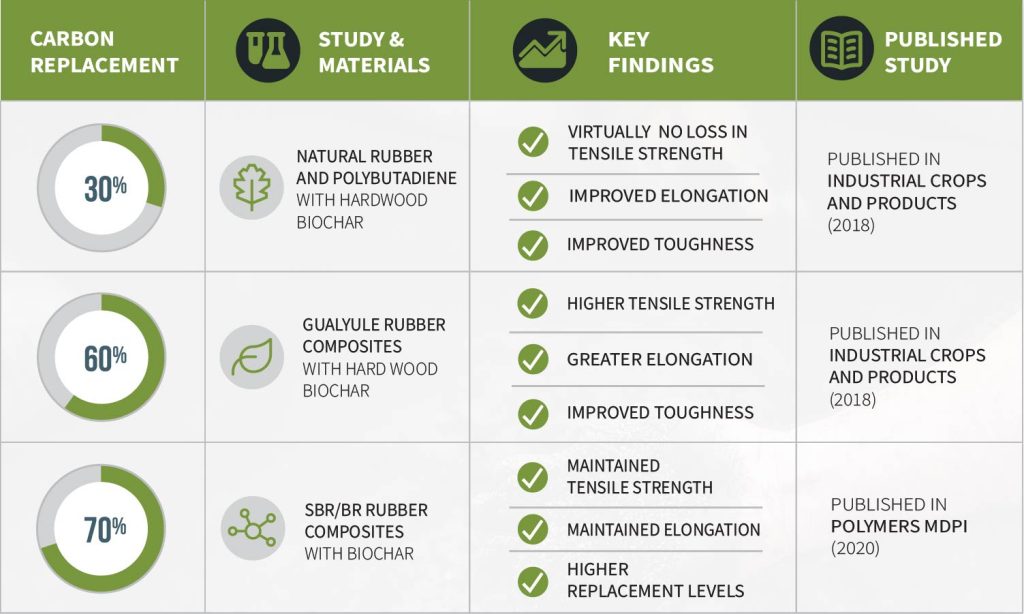
In a USDA study of guayule rubber composites, researchers replaced up to 60% of the carbon black with biochar produced from hardwood biomass. The resulting compounds showed higher tensile strength, greater elongation, and improved toughness compared to the carbon-black-only control. Researchers concluded the materials could be suitable for products such as gloves, belts, hoses, and seals.1
Another study evaluated hardwood biochar in natural rubber and polybutadiene blends. Researchers found that replacing approximately 30% of the carbon black resulted in virtually no loss of tensile strength while improving elongation and toughness.2
Additional research in SBR and BR rubber systems has demonstrated replacement levels approaching 70% while maintaining important mechanical properties.
Together, these studies suggest that engineered biochar may allow formulators to reduce carbon black loading while maintaining key performance characteristics.
Beyond Reinforcement
Researchers are also studying biochar for use in conductive polymer systems.
Production conditions can influence the structure and conductivity of biochar. Some high-temperature biochars have demonstrated electrical properties that may make them useful in conductive plastics, antistatic materials, and other specialty compounds.
Performance remains highly dependent on the formulation, but these studies show that biochar may have applications beyond traditional filler systems.
Why Manufacturers Are Exploring Biochar
Interest in biochar is not driven by performance alone.
Many manufacturers are looking for ways to:
- Reduce dependence on petroleum-derived raw materials
- Improve sustainability and ESG metrics
- Diversify supply chains
- Explore lower-carbon material alternatives
- Improve filler economics where technically appropriate
Because biochar is produced from renewable biomass and stores carbon in a stable form, it is attracting interest from companies developing more sustainable material solutions.
Where Biochar May Fit Best
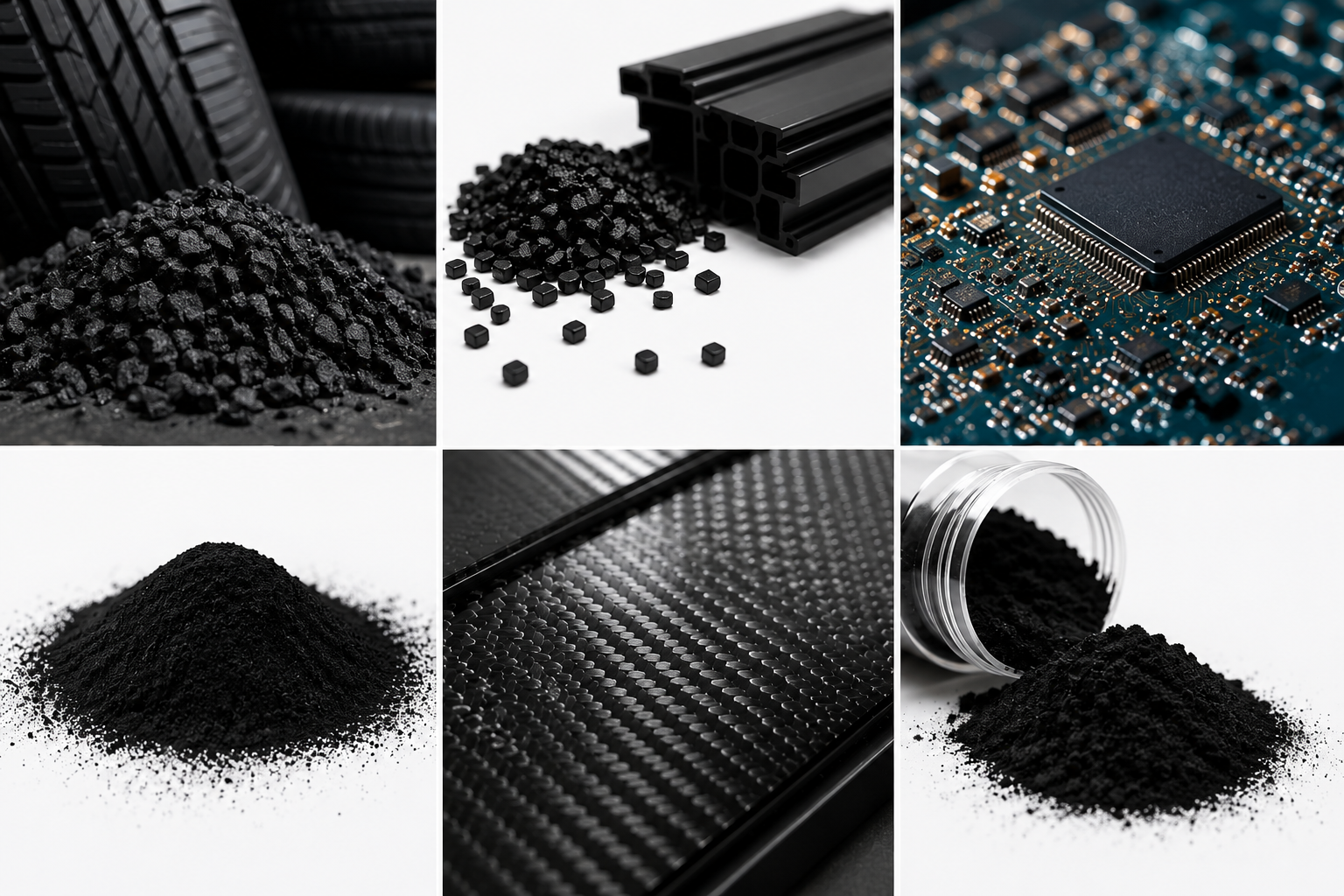
Current research suggests biochar may be most promising in:
- Rubber compounds
- Masterbatch formulations
- Conductive polymers
- Specialty fillers
- Industrial composites
- Carbon-based additive systems
As with any formulation change, performance depends on particle size, loading rate, processing conditions, and the specific material system being used.
Evaluating CarbonMicro® 50
CarbonMicro® 50 is Wakefield BioChar’s engineered biochar designed for industrial applications requiring a consistent, renewable carbon source. For manufacturers interested in reducing carbon black dependence, improving sustainability metrics, or exploring alternative carbon additives, CarbonMicro® 50 offers an opportunity to evaluate biochar in real-world formulations.
Published research continues to show that biochar is more than a sustainability material. Researchers are increasingly studying it as a functional carbon additive that may provide meaningful performance benefits in selected polymer and rubber applications.