
Can biochar help farmers use less chemical fertilizer while maintaining healthy soil and crop production?
A six-year study in northeast China explored that question in rice fields. Researchers compared conventional fertilizer with two treatments that combined rice-straw biochar with reduced amounts of nitrogen, phosphorus, and potassium fertilizer.
The results were promising, but they also showed that more biochar was not always better. A moderate biochar treatment improved soil structure and produced a higher rice yield than conventional fertilizer alone. A higher biochar treatment paired with greater fertilizer reductions did not perform as well.
Testing Biochar in Rice Fields
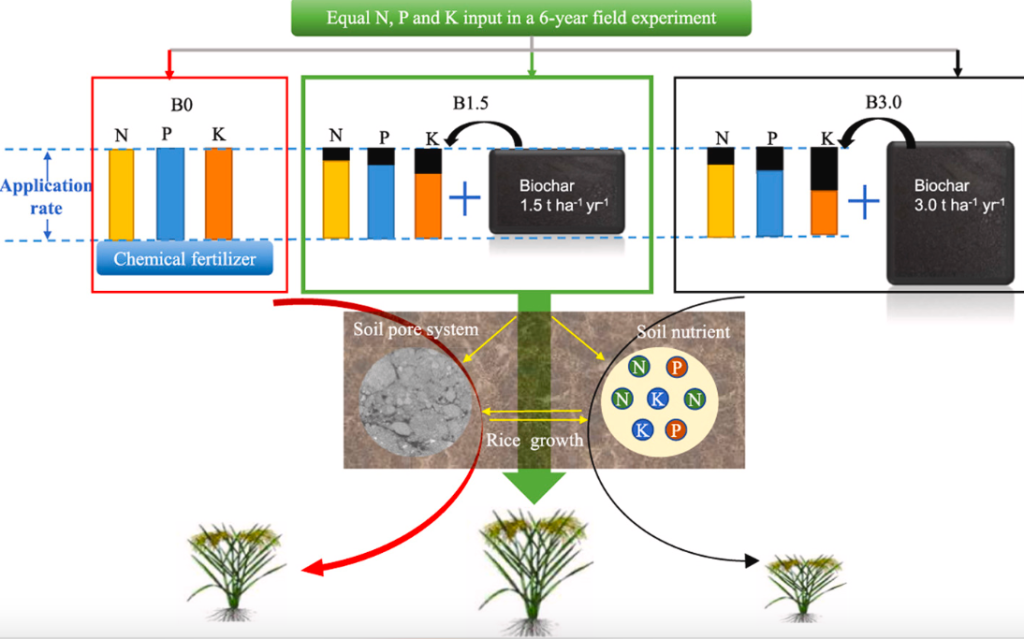
Researchers conducted the study over six years at a rice-growing site in northeast China. They wanted to understand whether biochar could replace part of the chemical fertilizer normally used to grow rice while maintaining soil fertility and crop yields. The study compared three treatments.
The first used conventional amounts of nitrogen, phosphorus, and potassium fertilizer with no biochar. A moderate treatment, called B1.5, added 1.5 metric tons of rice-straw biochar per hectare each year while reducing all three fertilizers. A higher treatment, B3.0, doubled the biochar to 3 metric tons per hectare and reduced fertilizer amounts even further. After six years, the researchers examined soil nutrients, soil structure, root growth, plant growth, and rice yield.
What Happened With the Moderate Biochar Treatment
The B1.5 treatment produced the strongest overall results.Even with less fertilizer, the soil maintained available nitrogen, phosphorus, and potassium at levels similar to the conventional fertilizer treatment. Rice yield increased by 6.6%. Plants in the moderate treatment also developed more roots and greater aboveground growth. Root length was 33.2% greater, and aboveground plant growth increased by 10.2%.
The researchers also found improvements in the soil itself. The moderate biochar treatment increased the amount and connectivity of larger pores in the soil. These spaces are important because they affect how air and water move through soil and how easily roots can grow. Together, the results suggest that the moderate combination of biochar and reduced fertilizer created better growing conditions at this site.
Why More Biochar Wasn’t Better
Doubling the biochar rate did not continue the positive trend. The B3.0 treatment used 3 metric tons of biochar per hectare each year, but it also reduced the amount of fertilizer more than the moderate treatment. This combination produced the lowest rice yield in the study.
The researchers also found less available nitrogen and weaker results for several measures of soil pore structure compared with the conventional fertilizer treatment. The lower nitrogen level is especially important. Plants need nitrogen to grow, and the researchers linked the weaker crop response in part to not having enough available nitrogen.
The result does not mean that the higher biochar rate itself caused the lower yield. Because the treatment combined more biochar with larger fertilizer reductions, the study shows the importance of balancing biochar use with the nutrient needs of the crop.
What This Study Tells Us About Biochar
This six-year study provides a useful example of how biochar can fit into agricultural soil and nutrient management. At the right combination, biochar improved soil structure and supported stronger root and plant growth while allowing researchers to reduce conventional fertilizer. The moderate treatment ultimately produced more rice than the full-fertilizer treatment.
Just as important, the higher treatment showed that biochar should not be treated as a direct replacement for all of the nutrients crops need. Increasing the amount of biochar while reducing fertilizer further left less nitrogen available and did not improve crop performance. The best biochar rate will depend on the soil, crop, biochar, climate, and nutrient needs of each growing system. But studies like this help researchers and growers better understand how biochar can become part of a more efficient approach to soil management.
Learn more about the benefits of biochar in agriculture and how biochar can support healthier agricultural soils.
References
-
Biochar application with reduced chemical fertilizers improves soil pore structure and rice productivity. Chemosphere, Volume 298, article 134304. July 2022. View Source