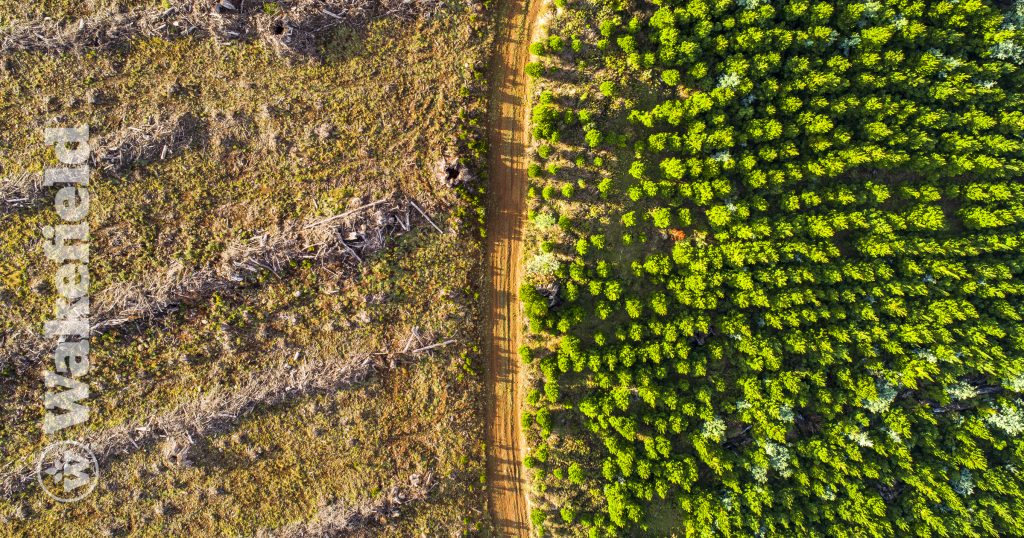
A tree draws carbon from the atmosphere as it grows, building that carbon into wood, bark and roots. After harvest, wood residues still contain part of that captured carbon. Turning those residues into biochar gives the carbon a longer life—and creates a useful material for the soil.1
That is the opportunity behind biochar for soil carbon sequestration: keeping plant carbon stored while putting it to work in farms and other growing environments.
Giving plant carbon a longer life
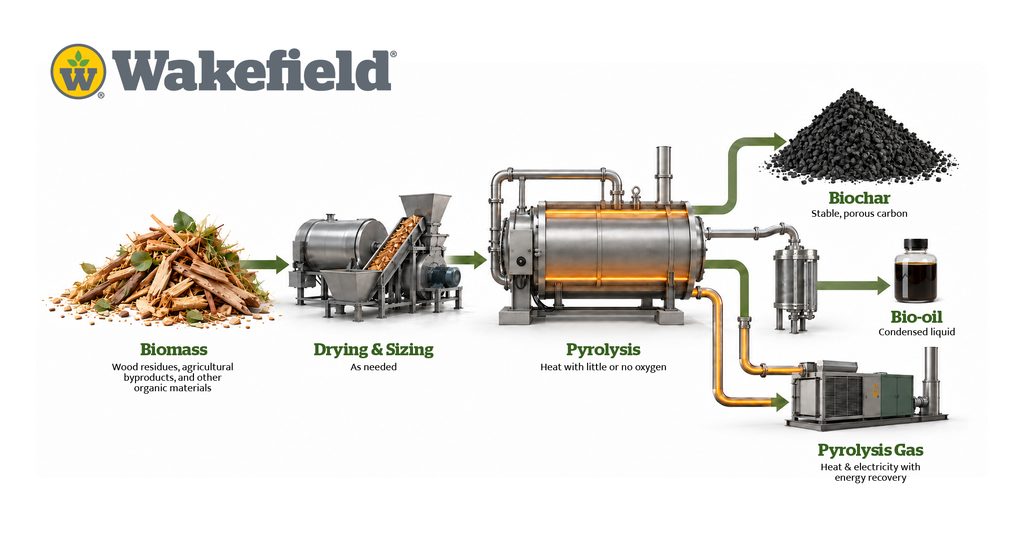
When wood decomposes or burns, much of its carbon returns to the atmosphere. Pyrolysis changes that path. Heating biomass with limited oxygen converts part of its carbon into a stable structure that breaks down much more slowly.1
Biochar’s resistance to decomposition makes it useful for long-term carbon storage. Its properties and the conditions in the soil help determine how long that storage lasts. Scientists use measurements and models to estimate persistence over centuries, giving carbon-removal programs a basis for assessing durability.2

Putting stored carbon to work in soil
The carbon-rich material also has a practical role around plant roots. Biochar’s pores and surfaces can help soil hold water and retain nutrients. In coarse or sandy soils, that added holding capacity can be especially useful.3
This brings carbon storage into everyday land management. Biochar becomes part of the growing environment, where its soil benefits give farmers and other land managers a reason to use the material. Our article on biochar and soil water retention explores that benefit in more detail.
Measuring the carbon-removal benefit
The first step is to measure how much carbon the biochar contains. Its dry weight and carbon percentage establish that amount. The next step estimates how much of the carbon will remain stored over the period being assessed. That stored carbon is then expressed as an equivalent amount of CO₂.1
Net carbon removal accounts for the work needed to achieve that storage. The assessment includes emissions from sourcing the biomass, making the biochar, transporting it and placing it into use. It also considers what would have happened to the biomass without the project and any indirect emissions the project causes. Under a verified methodology, these records establish how much CO₂ the project removes overall.4
Independent verification gives that result a documented basis. Our article on understanding biochar carbon credits explains how verified removal becomes credits and how carbon finance supports biochar production.
Wakefield’s contribution
Wakefield puts this process into practice by turning woody residues into biochar for agriculture and other durable uses. As of September 25, 2026, CDR.fyi reported 62,563 metric tonnes of delivered CO₂ removal for Wakefield, placing us first among North American carbon-removal suppliers and fifth among biochar suppliers worldwide, measured by cumulative delivered removal.5
Carbon-removal revenue helps support the production and delivery of that material, making biochar more affordable for agricultural use.6 The result connects a global climate goal with a practical local use: storing carbon in a material that can help improve soil.
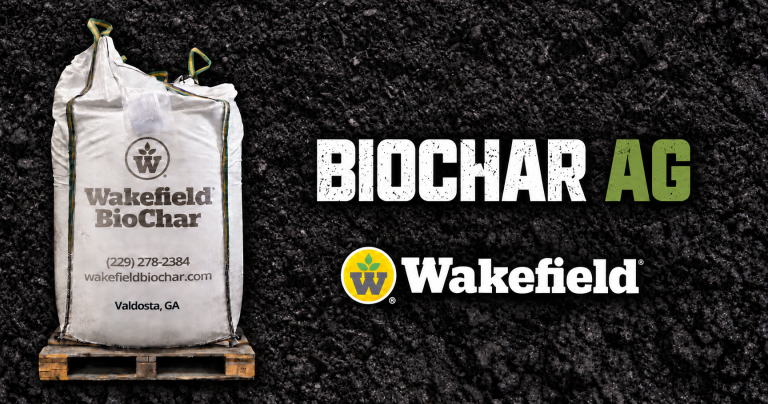
Explore Wakefield’s agriculture solutions for biochar product options, bulk quantities and delivery.
Sources and notes
-
Biomass residue to carbon dioxide removal: quantifying the global impact of biochar 2023. Framework for estimating biochar carbon storage and net removal, including production, transport and application emissions. View Source ↩
-
Advancing the Science of Biochar Permanence 2025. Explains how biochar properties, storage conditions and scientific models inform estimates of carbon persistence. View Source ↩
-
Soil Restoration with Biochar 2024. Soil guidance describing biochar’s water- and nutrient-retention benefits, with particular relevance to coarse-textured soils. View Source ↩
-
Biochar Methodology, Edition 2025, Version 2 2025. Framework for biomass sourcing, durable storage, project emissions, monitoring and verification. View Source ↩
-
Carbon Removal Leaderboard and Wakefield Biochar Supplier Profile 2026. Cumulative delivered removal: 62,563 tonnes. Wakefield ranks first in North America across all methods, sixth globally across all methods, and fifth globally among biochar suppliers. Filters: Suppliers, Delivered, All time; North America / All methods for the regional ranking. View Source ↩
-
Wakefield BioChar 2026. Project description explaining how carbon revenue supports processing, hauling and soil application, alongside access for farmers. View Source ↩