Tall fescue depends on the soil beneath it. A root zone that manages water, nutrients, and air well gives the grass a stronger foundation for establishment and long-term growth.
An early container demonstration prepared for Wakefield BioChar explored how tall fescue responded to several amounts of biochar. Newer turf studies add useful field evidence to that initial observation. Together, they show where biochar can support tall fescue and why the amount used matters.
An early look at tall fescue and biochar
The container demonstration compared soil and compost blends containing 5%, 8%, 10%, 12%, and 15% biochar by volume. Pots without biochar provided a visual comparison.
Tall fescue seeds grew indoors under continuous lighting for about 20 days and received daily watering. The grass grown with 5% biochar showed the strongest visible growth.1
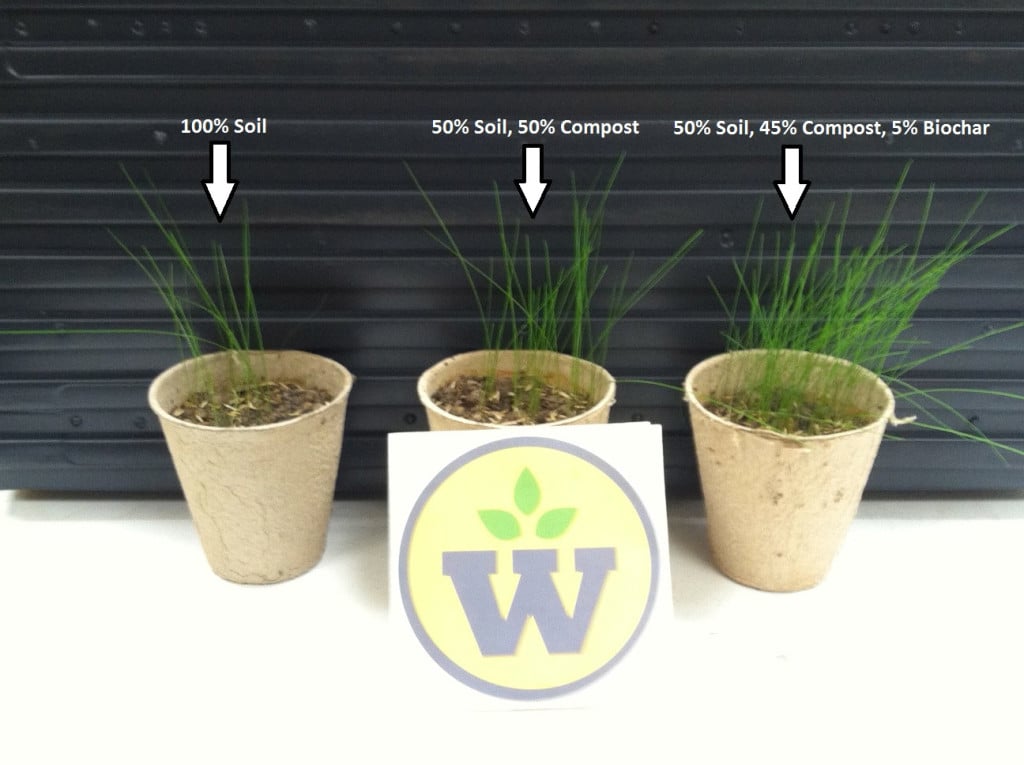
The demonstration offers a useful visual example, but it was not a complete controlled experiment. It did not record plant weight, root length, water use, or statistical comparisons. The 5% result should therefore be treated as a promising observation rather than a universal optimum.
Its practical message remains useful: a modest amount of biochar mixed into the soil supported vigorous early growth. Increasing the amount beyond 5% did not produce an equally clear visual improvement.
What later field research adds
A University of California, Riverside study gives the early demonstration more context. Researchers established tall fescue in field plots amended with biochar, compost, or combinations of the two.
Under adequate irrigation and fertilization, tall fescue established at a similar rate in soil with and without biochar. That is a useful result. It shows that incorporating biochar did not slow the formation of turf cover.2
The research program then followed the turf under limited irrigation. First- and second-year studies found that the response depended on the amount of biochar and the irrigation level. Selected biochar rates supported turf quality and growth when water was limited. In the second year, a moderate rate performed especially well under deficit irrigation.3
Severe water restriction still reduced turf quality. Biochar supported the root zone, but it did not eliminate the grass’s need for water.
Why biochar can help the turf root zone
Biochar contributes a durable network of pores and surfaces to the soil. That structure can hold water and nutrients within the root zone while preserving space for air and root growth.
For tall fescue, these properties can help in several ways:
- Keep more moisture available between irrigation cycles
- Retain nutrients within reach of the roots
- Add lasting structure to amended soil
- Support soil organisms involved in nutrient cycling
- Build carbon into the root zone
These are soil benefits, not a replacement for irrigation or fertility. Biochar works as part of the growing environment alongside soil, compost, fertilizer, and sound turf management.
A moderate amount can do meaningful work
The early container demonstration and later field research point in the same general direction: more biochar is not automatically better.
The container demonstration’s strongest visible growth occurred at 5% by volume. Later field trials also found rate-dependent results, with moderate biochar performing well under limited irrigation.1, 3
This supports using biochar as a purposeful part of the root-zone blend. The goal is to add useful pore structure and carbon without allowing biochar to dominate the soil mixture.
Putting biochar where roots can use it
For new turf and renovated soil, biochar can be blended into the active root zone before seeding or laying sod. Mixing it with soil or compost distributes the material and places it where developing roots can reach it.
For established turf, biochar can be worked into aeration openings during planned soil maintenance. This moves the material below the surface and reduces the chance that lightweight particles will be displaced.
The tall-fescue evidence provides a focused example of the broader opportunity described in Biochar for Professional Turf Management. For application planning and product options, visit Landscaping & Turf.
References
-
Tall Fescue Biochar Container Demonstration Container demonstration 2015. Tall fescue was grown for approximately 20 days in soil-and-compost mixtures containing 5%, 8%, 10%, 12%, or 15% biochar by volume. The comparison was visual; original measurements, replication details, and a complete report were not available. ↩
-
Effects of Biochar and Compost on Turfgrass Establishment Rates Agronomy, 14(5), 960 2024. Field and greenhouse research found no significant difference between tall fescue establishment in untreated and biochar-amended soil under adequate irrigation and fertilization. Root and soil responses varied by amendment and setting. View Source ↩
-
First- and Second-Year Effects of Biochar, Biosolids, and Greenwaste on Tall Fescue Under Deficit Irrigation Agronomy 2026. Related assessments from the same field site, not independent trials. Moderate biochar supported favorable second-year performance under limited irrigation, while severe water restriction still reduced turf quality. First-year paper: https://doi.org/10.3390/agronomy16131283. View Source ↩