

Yes, biochar can help grass grow when it improves the soil conditions limiting that grass. Turf research has found benefits from particular root-zone mixtures, alongside trials where biochar did not speed establishment. The soil, biochar, grass species and growing conditions all matter. 1 2
What biochar can change below the grass
Biochar can change how a root zone stores water and nutrients. In research on sand-based turf mixtures, increasing biochar increased water storage. However, water moved through saturated mixtures more slowly, and higher biochar proportions reduced bentgrass rooting depth. More water retention did not mean every aspect of the mix improved. 3
This makes biochar worth considering where soil loses moisture quickly, while keeping drainage and the finished mixture in view. It does not replace the nutrients grass needs. Our articles on soil water retention and biochar and fertilizer explain those complementary roles.
What turf research shows
In simulated golf greens, particular biochar-and-compost mixtures increased creeping bentgrass shoot height and dry weight compared with a peat-amended control under reduced chemical fertilization. The plants grew in tubes containing sand-based mixtures. The results concern those whole mixtures, including their compost, rather than proving that biochar alone caused the improvement. 1
A University of California, Riverside field report found no statistically significant difference in tall fescue establishment between untreated and biochar-amended soil under adequate establishment irrigation. 2 Together, these findings support a practical expectation: biochar may improve a suitable growing medium, but it is not a shortcut to faster germination in every lawn.
Wakefield’s grass-seed demonstration
Our demonstration compared topsoil alone, equal parts compost and topsoil, and a compost-and-topsoil mixture described as containing 10 percent biochar. The account records the same seed, water and light for each section. By day 10, it reported more seedlings and taller visible growth in the biochar mixture than in the other sections. 4
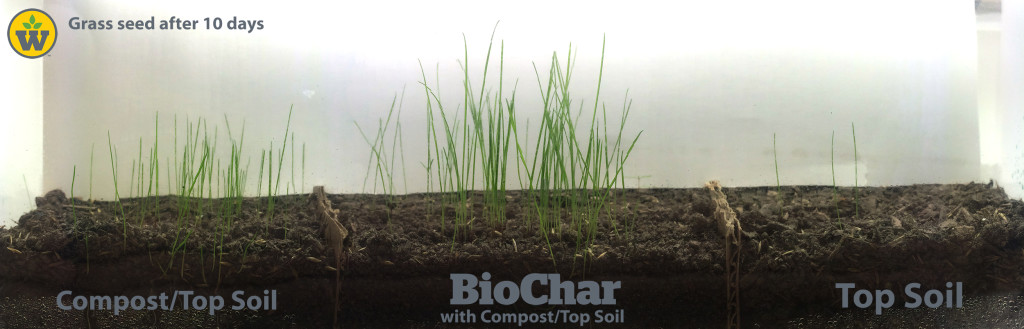
That is an encouraging observation from a small demonstration. It does not establish how much faster a lawn will fill in, which soil change caused the difference, or how established turf will respond over a season. The demonstration’s mixture is not a lawn application prescription; use the directions for the product and project you choose.
Plan around your lawn and access to the soil
Start by identifying why the grass is struggling. Shade, mowing practices, compaction, drought and low fertility can each contribute to thin turf. A soil test helps guide amendment and nutrient decisions, and basic lawn-care changes may address the problem without full renovation. Choose grass suited to the site and follow local guidance for seeding and seasonal care. 5
For a new lawn, Wakefield Premium Biochar directions call for incorporation into the top soil layer before seeding or laying sod. For existing lawn repairs or patches, the directions call for aerating first and raking biochar into the openings. Follow the product’s mixing guidance and keep irrigation appropriate for the grass. 6
Explore our Gardening options for home projects. Contractors and grounds crews planning larger work can use Landscaping & Turf to discuss application access, material selection and supply.
Sources and notes
- Vaughn et al. (2018). Biochar-organic amendment mixtures added to simulated golf greens under reduced chemical fertilization increase creeping bentgrass growth. USDA ARS technical abstract; specific mixtures, not a home-lawn trial.
- Montgomery, Baird and McGiffen (2015). Effects of Biochar on Turf Establishment. UC Riverside field report; establishment results under adequate irrigation.
- Brockhoff et al. (2010). Physical and Mineral-Nutrition Properties of Sand-Based Turfgrass Root Zones Amended with Biochar. Agronomy Journal. Abstract-level evidence on water and rooting.
- Wakefield BioChar internal records and application information. Historical grass-seed demonstration; informal observation, not a replicated lawn trial.
- University of Minnesota Extension. Renovating a lawn for quality and sustainability. Reviewed 2024; diagnosis and soil-testing guidance.
- Wakefield Premium Biochar package instructions. Manufacturer application guidance for new lawns and existing repairs.